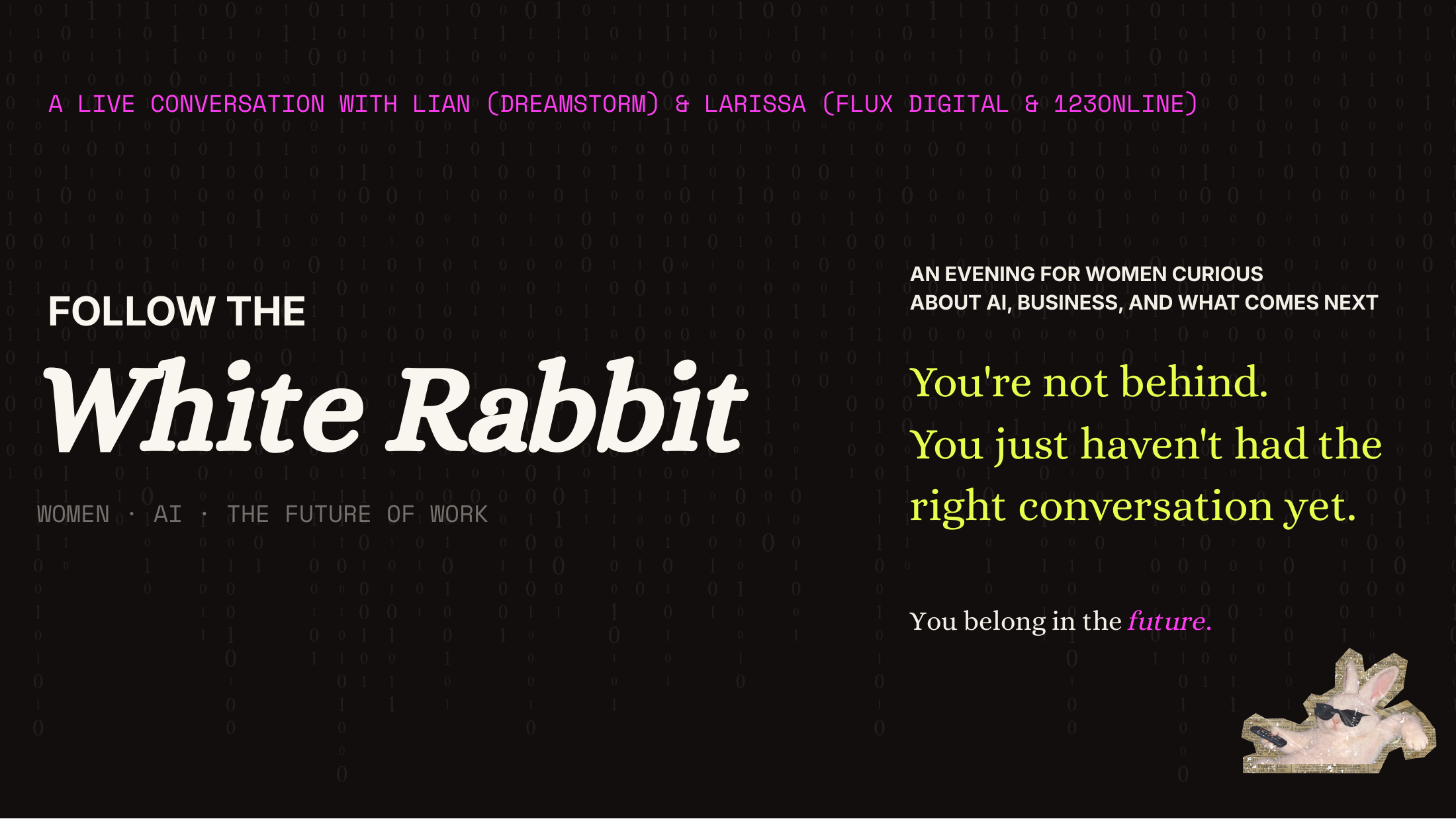
FOLLOW THE White Rabbit
You belong in the future.
Everything from the night, in one place. We packed a lot into one evening, so take it at your own pace, it's all still here.
You said you'd try one thing this week. The Context Kit just below is where to start, then your questions answered in writing, the slides, the video, and a free module to keep going.
Start with context. Everything else gets easy after that.
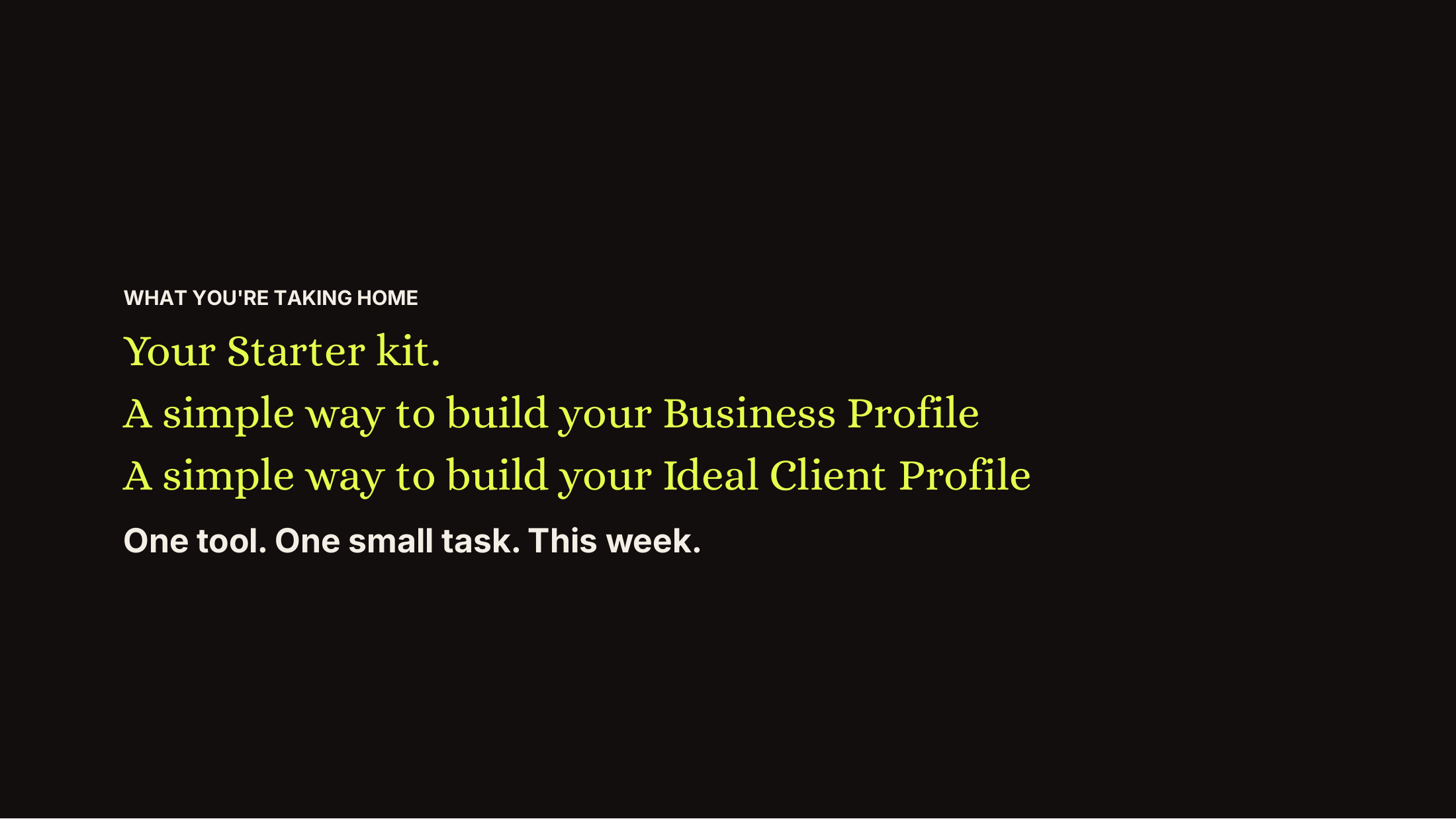
You said you'd try one thing this week, this is the one. The thing that makes AI useful is what you already know about your business. These two templates help you write it down once, so you never have to explain yourself to a robot again.
Template 01 Your Business Profile
+
Your Business Profile
This template is built to quickly outline who you are, what you sell, and how you actually sound in your own voice.
- Defines your core services and primary audiences.
- Identifies tone-of-voice traits to prevent sounding generic.
- Includes pre-baked prompts to feed directly to AI.
Template 02 Your Ideal Client Profile
+
Your Ideal Client Profile
Perfect for outlining exactly who you are talking to, capturing their pain points, priorities, and vocabulary.
- Pinpoints client obstacles, goals, and buying triggers.
- Provides instructions to align AI drafts with target client values.
- Ensures all generated outputs fit real-world client conversations.
The slides, with the talk.
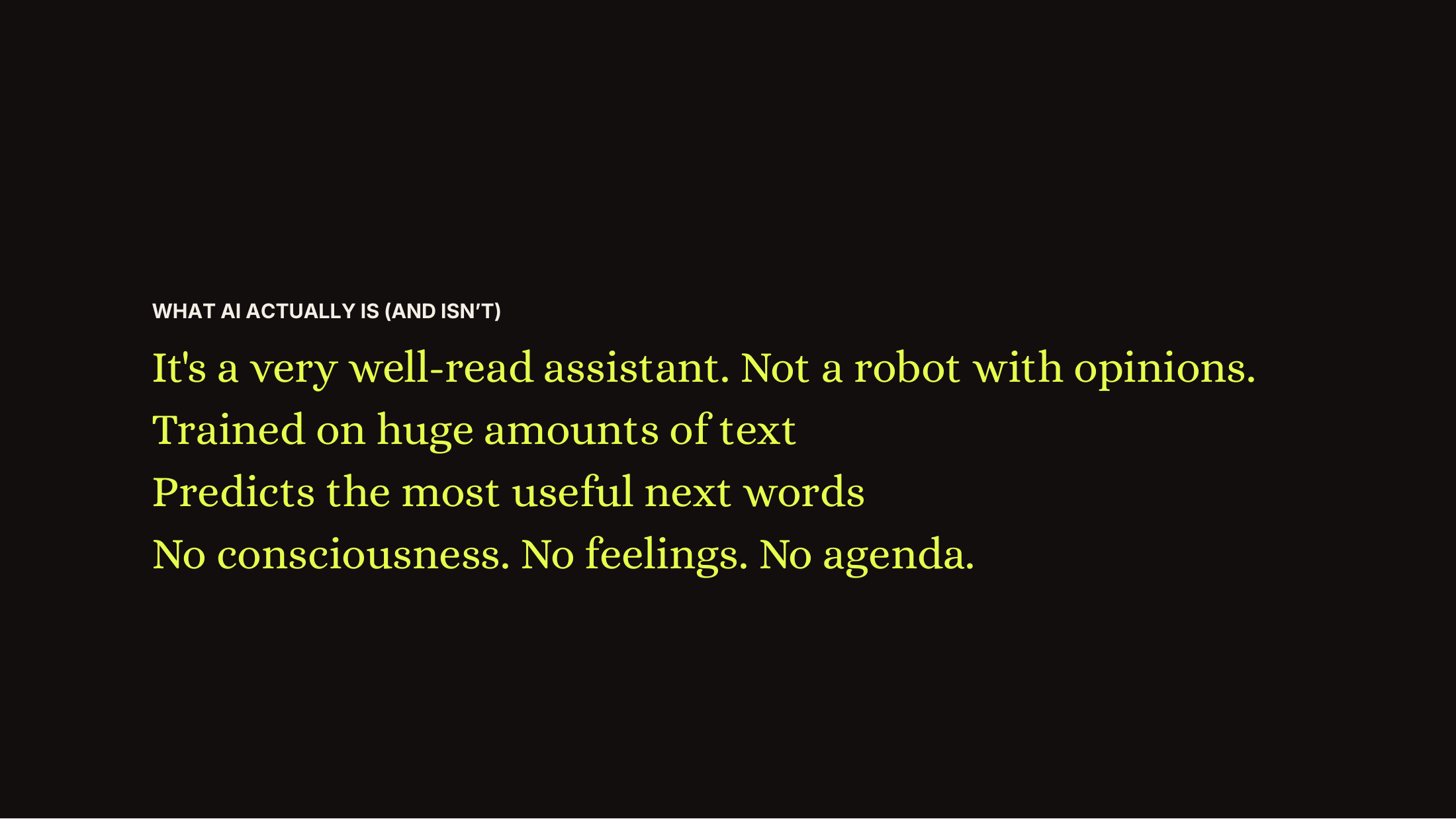
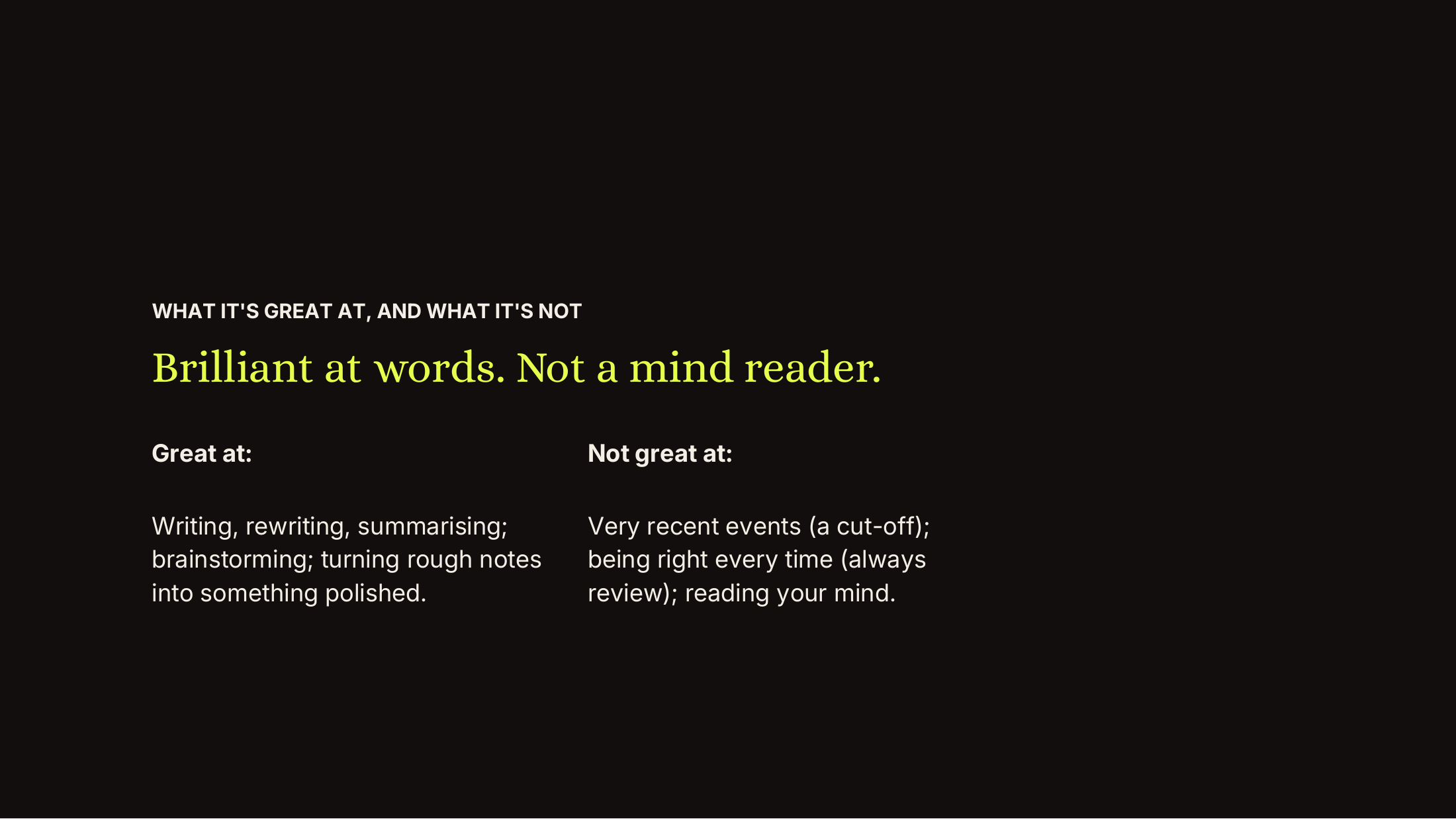
Walk the whole deck at your own pace. Where a slide has audio, press play to hear what was said when it was up on the screen — or open the notes to read it instead.
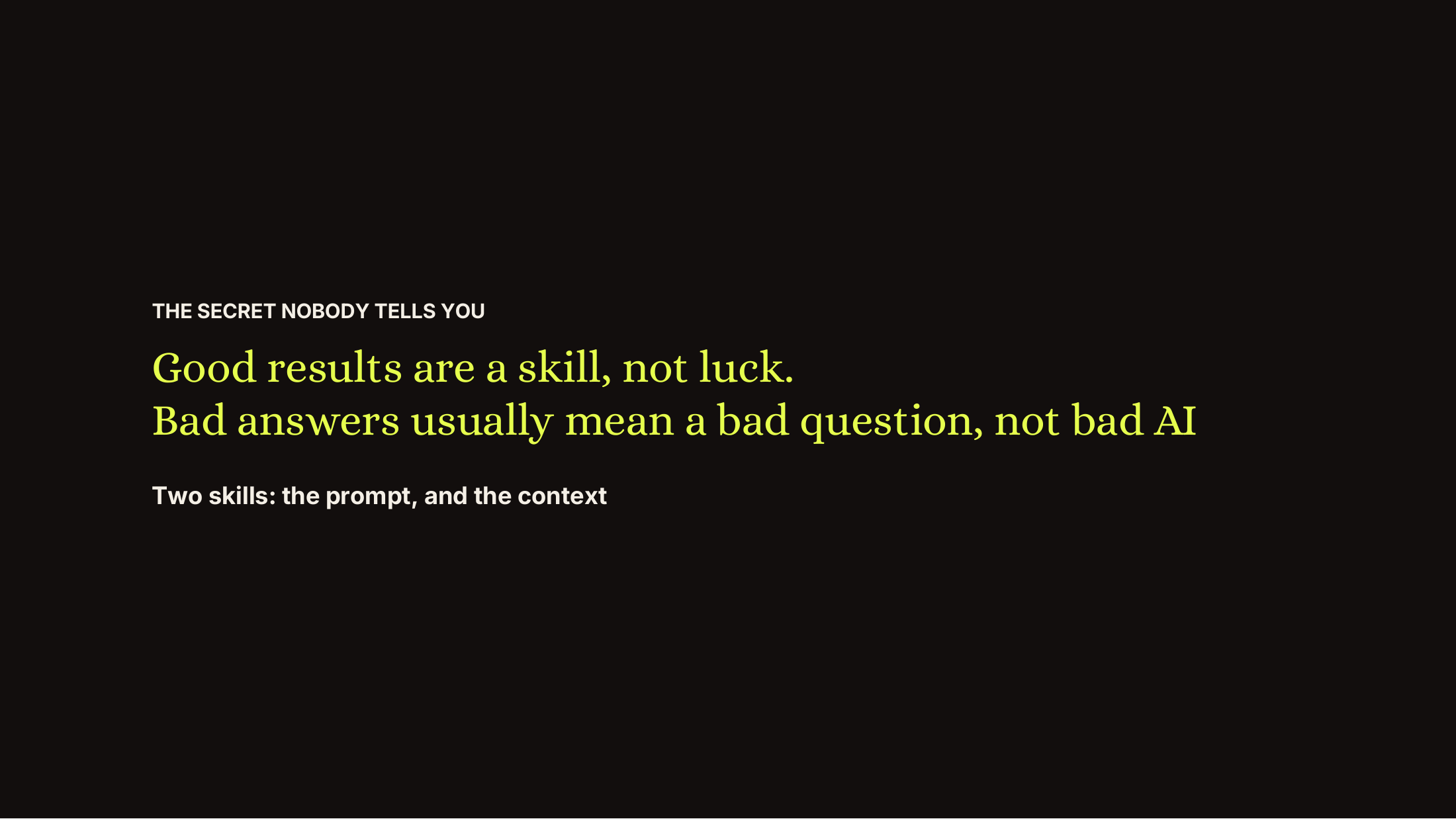
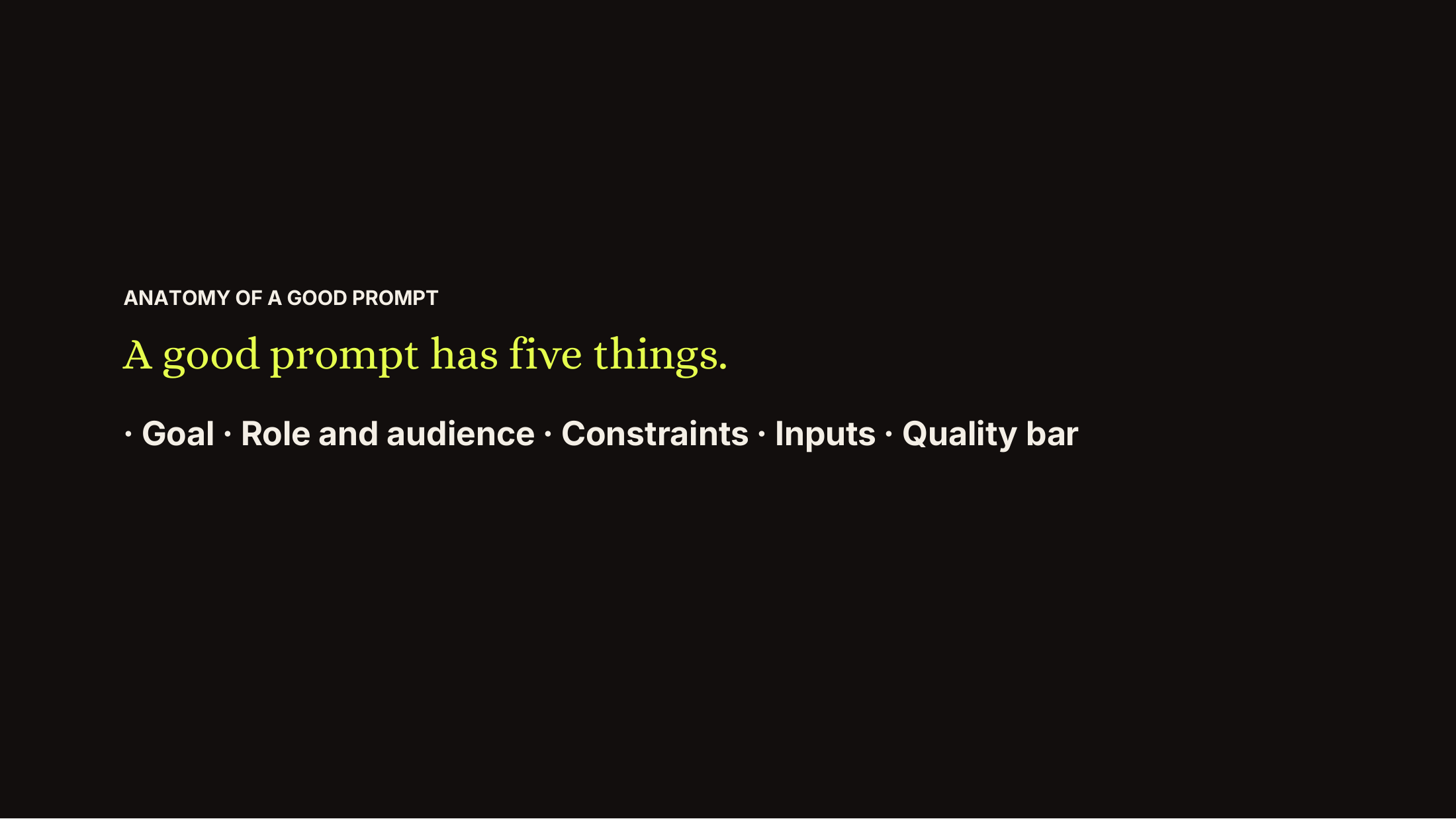
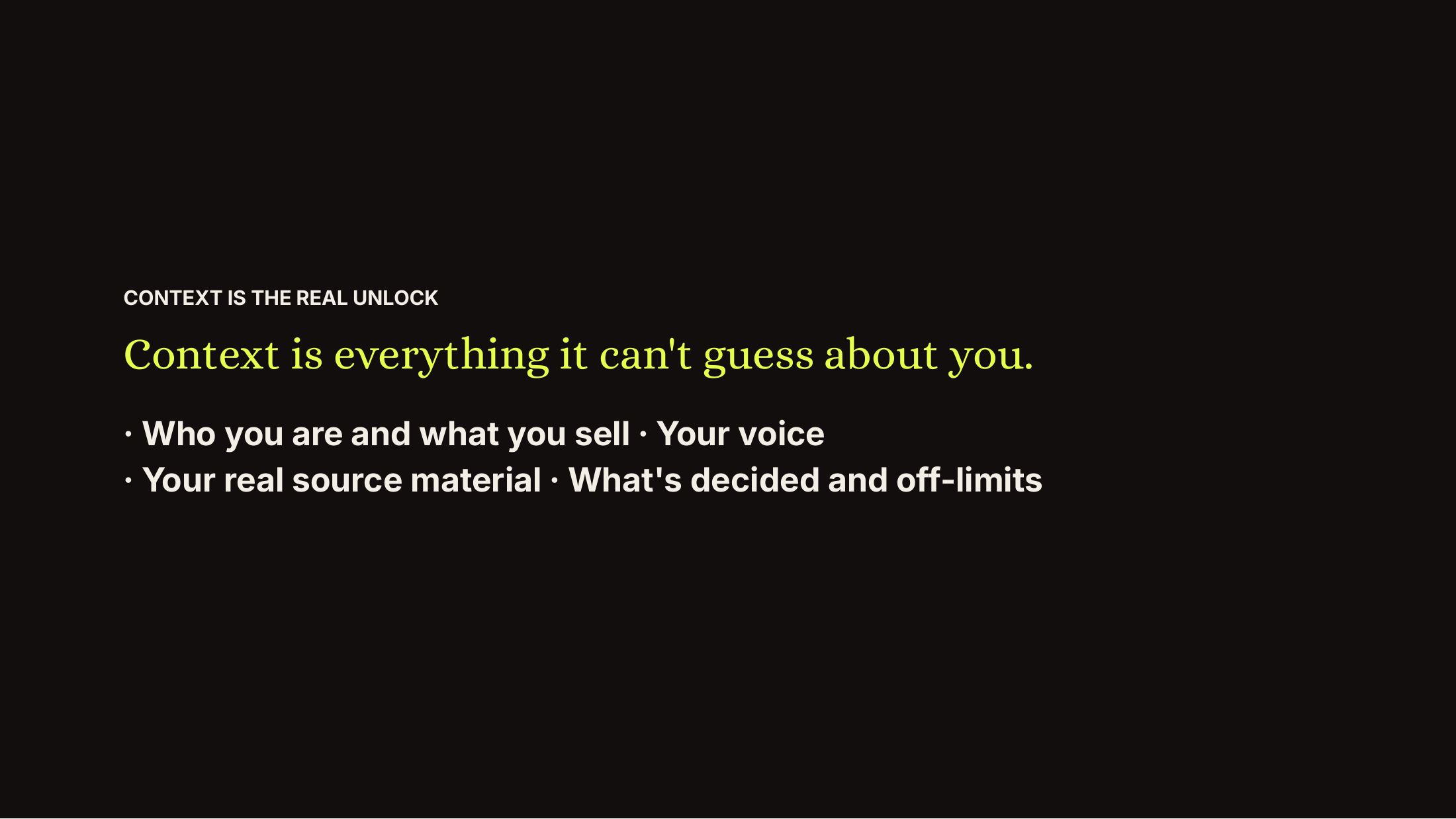
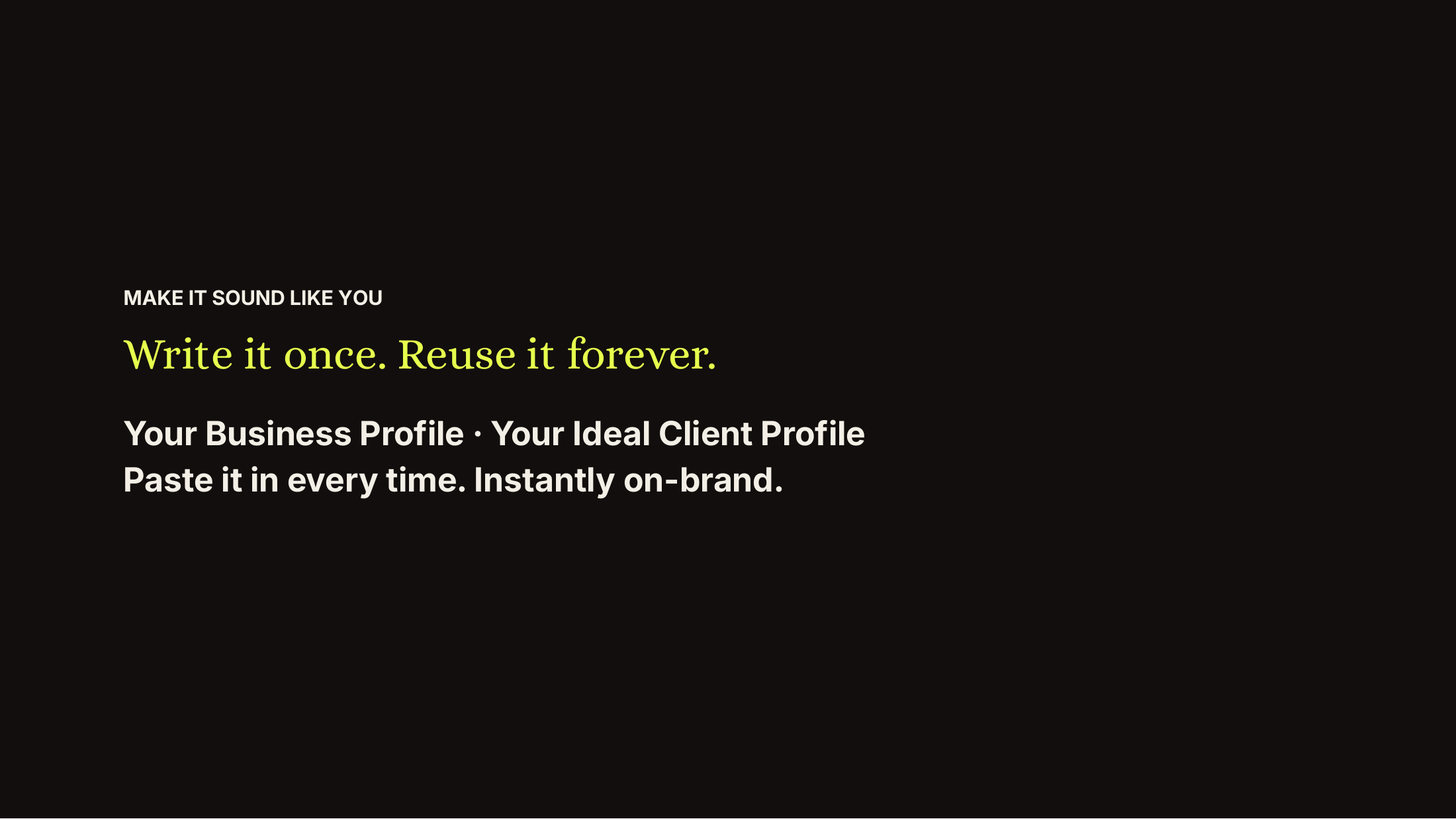

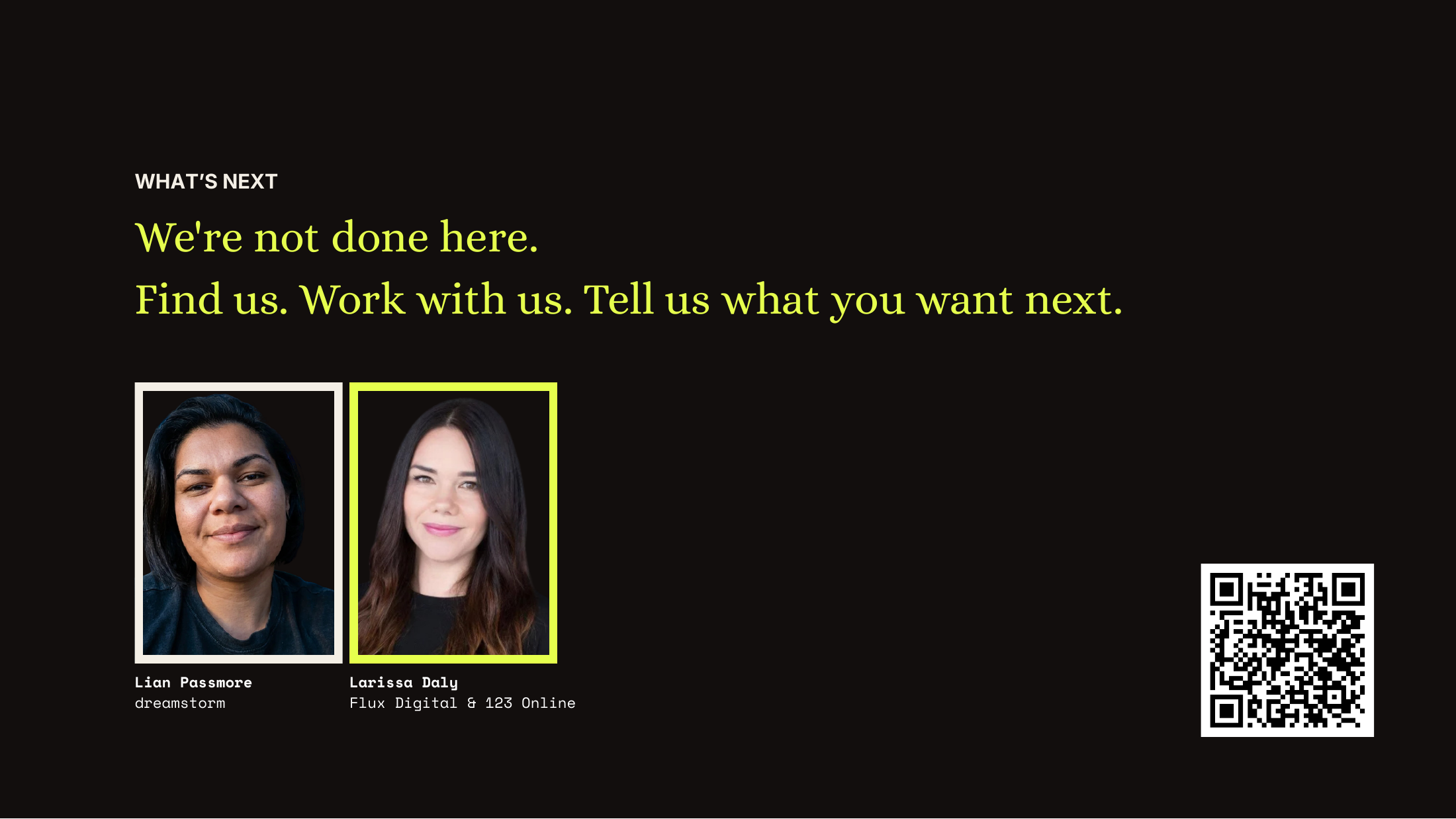
1 / 28
Speaker notes
Press play to hear the whole talk — it moves through the slides for you. ← → to jump, N for notes.
The photos.
Nimmy was in the room all evening capturing it, with her partner Drew helping out alongside her. The gallery is live — head in, find yourself, and grab whatever you love.
Take your time and relive some of the moments from the evening. If you share any of these publicly, Nimmy would really appreciate a credit as Photography by Nimmy or @bynimmy on social.
Open the gallery →
Photos by Photography by Nimmy, with Drew · @bynimmy · more about Nimmy →
Your questions, answered.
Every question that came in, from the registration form right through to the night, answered in writing and grouped into themes where it fits. A lot of you asked a version of the same thing, so we've answered those once, together. First names are kept where they were asked openly. Lian & Larissa
Tap any question to open the answer.
Where to start, and making work easier
Where do I even start?
asked, in one form or another, by a lot of you: Rachel, Teale, Leanne, Arwen, Lisa, Jessica, Michelle, and everyone who wrote "just here to learn," "making sense of it all," "going in blind," or "not to be left behind"
+
Where do I even start?
asked, in one form or another, by a lot of you: Rachel, Teale, Leanne, Arwen, Lisa, Jessica, Michelle, and everyone who wrote "just here to learn," "making sense of it all," "going in blind," or "not to be left behind"
This was the most common thread of the whole night, so if it was you, you were in very good company. Start with one task, not a transformation. Pick the thing you do every week that you'd happily never do again, and a lot of you named yours at the stations: emails, quotes, reports, admin. Take just that one thing and, for a week, do it with AI alongside you, asking it to draft, simplify or speed up each step.
You don't need a grand plan, and "going in blind" is exactly the right way to walk in. The Context Kit on the hub (your Business Profile and your Ideal Client Profile) is the highest-leverage starting point there is. Once AI knows who you are and who you serve, everything else gets easier. Then Larissa's free Demystifying AI module picks up from there at your own pace. You don't need a strategy yet. You need one small win.
Any AI you'd recommend for analysing data and reporting, say from a job management system?
Michelle
+
Any AI you'd recommend for analysing data and reporting, say from a job management system?
Michelle
For most small businesses you don't need a special tool. Claude or ChatGPT will do a lot here. Export your data from the system as a CSV or spreadsheet, upload it if the tool lets you, and ask in plain English: "summarise jobs by month," "which clients are most profitable," "draft a one-page report from this." Claude is particularly strong at working through a spreadsheet and showing its reasoning.
Two notes. Strip or anonymise anything personal before uploading (see the privacy answers below), and always sanity-check the numbers on anything that matters, because AI can make confident arithmetic mistakes. If you outgrow that, the next step is connecting the system directly, something like Power BI or a proper integration, which is more of a strategy-session conversation.
How does Claude "post to social media" for you, via something like Metricool?
asked anonymously
+
How does Claude "post to social media" for you, via something like Metricool?
asked anonymously
Good catch. Claude (or ChatGPT) doesn't actually log in and post by itself. What it does brilliantly is create the content: captions, hooks, a month of posts from a single idea, in your voice. To get it published, you connect it to something that does the posting. Either you copy and paste into your scheduler (Metricool, Buffer, Later, Meta's own planner), or you wire it up with an automation tool like Zapier or Make so a generated post flows into your scheduler automatically.
Newer versions can connect to some tools more directly, but for now the simple version is: AI writes it, your scheduler posts it. Honestly, copy and paste into Metricool is the simplest reliable setup, and where we'd start.
Can I create an AI version of myself so I don't have to do any more awkward-af videos?
Nicolette
+
Can I create an AI version of myself so I don't have to do any more awkward-af videos?
Nicolette
Yes, the tech exists. Tools like HeyGen and Synthesia build a video "avatar" from a sample of you, and others can clone your voice, so you type a script and "you" delivers it. It genuinely works and people use it for repetitive content.
The honest caveat: audiences can increasingly tell, and the thing that makes your content land is usually the real, slightly awkward, human you. Our take is to use an avatar for the boring, repeatable stuff (FAQs, course intros, updates) where polish matters more than presence, and keep your actual face for the moments that build trust. And before you outsource your face entirely, let AI do the heavy lifting around the video first: scripts, teleprompter, editing. That alone makes the awkward bits a lot less awkward.
Can you really build apps and tools with AI now?
Anisha
+
Can you really build apps and tools with AI now?
Anisha
We held this one on the night because it's a rabbit hole of its own, but here's the short version: yes, and it's real. You can now describe a simple tool in plain English, a booking form, a little calculator, a way to sort some data, and AI will build a working version with no code from you. It's early, it isn't magic, and the more involved the thing gets the more it helps to know what you're doing. But the floor has dropped right out of what it costs to turn an idea into something that actually works.
The honest advice: get solid on the everyday stuff first, the context kit, using it as a daily assistant, then come and find one of us when you want to go down this path. It deserves a proper conversation, not a paragraph.
Tools, tokens and getting better results
With prompts, is it better to keep refining, or start over with a better request?
asked anonymously
+
With prompts, is it better to keep refining, or start over with a better request?
asked anonymously
Both, and knowing which is the real skill. If the answer is close but off in tone or detail, keep going in the same chat: "make it warmer," "shorter," "now do it for this client." The AI remembers the context and builds on it. If it's gone genuinely off track, wrong direction, confused, talking in circles, start a fresh chat with a better opening prompt. Once a conversation is muddled, it tends to stay muddled.
Rule of thumb: refine to improve, restart to redirect. And the best fix is almost always a stronger first prompt: who it's for, what you want, what "good" looks like, and a bit of context, which is exactly what the Context Kit gives you on tap.
What else is there besides ChatGPT, and how do I get better answers out of it?
Kellie
+
What else is there besides ChatGPT, and how do I get better answers out of it?
Kellie
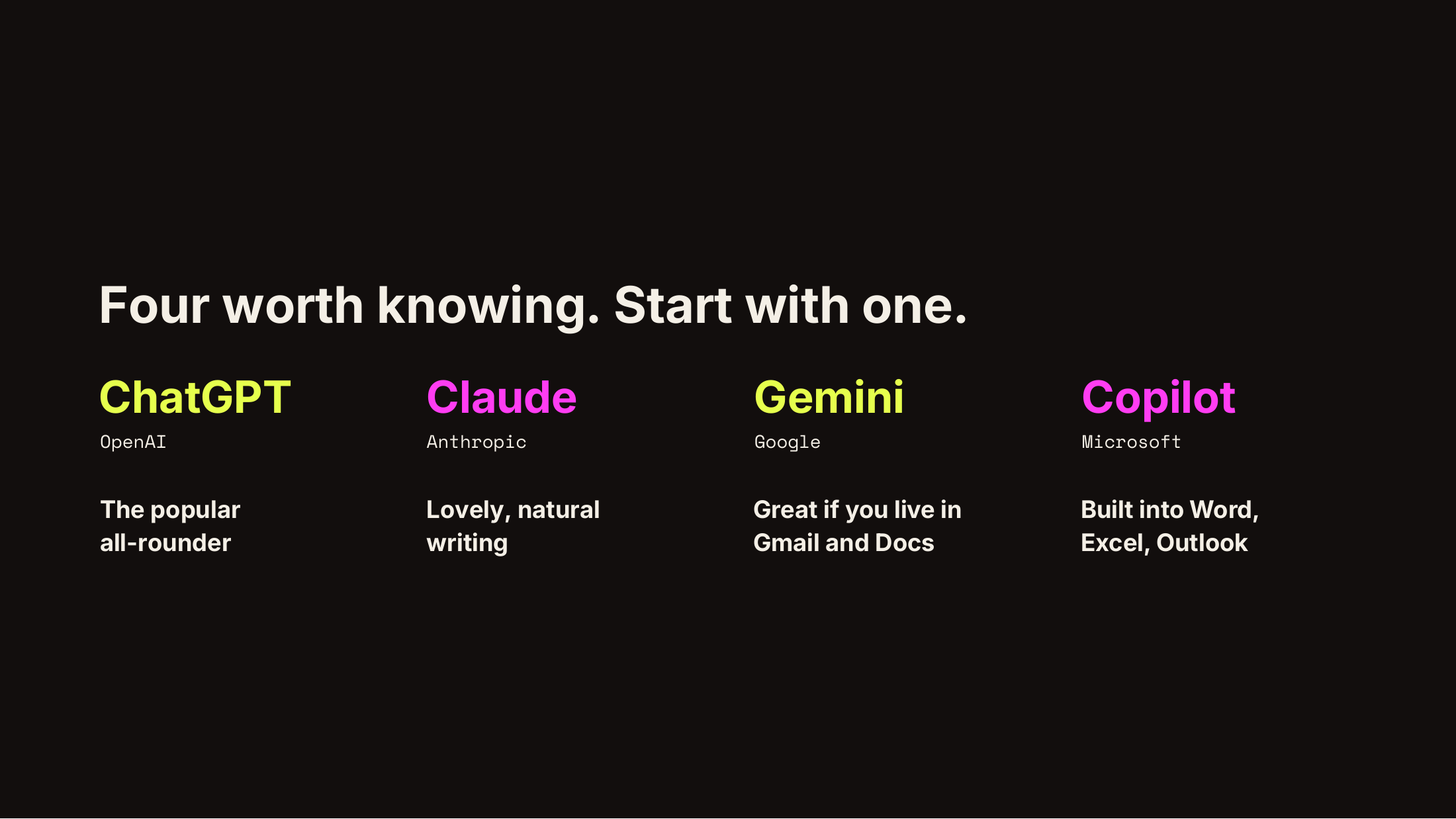
On tools, there are four worth knowing, and they mostly do the same thing. ChatGPT is the popular all-rounder. Claude is known for lovely, natural writing, and it's what we used for the live demo. Gemini is Google's, and it's great if you live in Gmail and Docs. Copilot is Microsoft's, built into Word, Excel and Outlook. Our advice: pick one, get good at it, and the skill carries across.
On getting better answers out, that's the whole "context" thing from the night. The quality of what comes back is mostly down to the quality of what you put in: who it's for, what you want, and enough background about you and your business that it isn't left guessing. The Context Kit on the hub is built to do exactly that.
You've mentioned tools like Claude. Will they stay free, and can you explain tokens?
Anisha
+
You've mentioned tools like Claude. Will they stay free, and can you explain tokens?
Anisha
Two parts. On tokens: AI reads and writes in "tokens," little chunks of text, roughly three-quarters of a word each, so a short sentence is often around 15 to 20 tokens. It matters for two reasons. The tools are charged by tokens behind the scenes, and each model can only hold so many tokens at once, its "memory" for a conversation, which is why very long chats sometimes start forgetting the beginning.
On free: the big tools (Claude, ChatGPT, Gemini) all have genuinely useful free tiers, and we expect those to stick around, because they're how you get hooked. But free comes with limits: fewer messages, the older or smaller models, and a wall on busy days. If AI becomes part of how you work, the paid tier, around NZ$30-ish a month at current prices, pays for itself fast in time saved. Think of free as "try everything," and paid as "now it's a tool I rely on."
The bigger picture: jobs, careers and the future
What skills should kids be learning now because of AI?
Kayla
+
What skills should kids be learning now because of AI?
Kayla
The instinct is to teach "how to use the tools," but those change every year. The skills that last are the human ones AI doesn't have: asking good questions, judging whether an answer is actually true, thinking critically, creativity, and knowing what you actually want in the first place. Curiosity and the confidence to learn new things beats any single tool.
Practically: let them use AI as a thinking partner and a tutor, but keep them doing the hard parts themselves, writing, maths, reading real books, so they build the judgement to spot when AI is wrong. The kids who thrive won't be the ones who can prompt. They'll be the ones who can think, and who aren't afraid of the technology.
If AI keeps improving, what will it realistically do in 5 to 10 years, and which jobs will be fully done by AI?
asked anonymously
+
If AI keeps improving, what will it realistically do in 5 to 10 years, and which jobs will be fully done by AI?
asked anonymously
Honestly, anyone who tells you precisely is guessing, including the people building it. The realistic direction: AI keeps getting better at tasks, writing, summarising, analysis, coding, customer support, design drafts, so more of those get automated. But a job is a bundle of tasks, judgement and relationships, and those are much harder to replace wholesale.
The pattern so far is that AI changes jobs more than it deletes them. The person who uses AI well tends to replace the person who refuses to. Most exposed: routine, screen-based, repetitive work. Most protected: anything built on people, trust, hands and judgement. Which is exactly why we'd rather you were in the room learning it than waiting to see.
How do you see us working with AI in 2 to 5 years?
Charlotte, Northpower
+
How do you see us working with AI in 2 to 5 years?
Charlotte, Northpower
Anyone who gives you a precise picture is guessing, so take this as direction, not a forecast. But the direction is fairly clear. The biggest shift is that AI stops being a separate thing you go and open. It gets baked into the tools you already use, Outlook, Teams, Excel, your internal systems, so it's just there in the background, the way spellcheck is now. The "go to ChatGPT" step quietly disappears.
Day to day, your job tilts from doing the task to directing and checking it. Less typing from scratch, more "draft this, pull that together, summarise these," then you review and decide. For somewhere data-heavy like Northpower, the near-term wins are the obvious ones: meeting notes and actions captured automatically, reports drafted straight from the data, and being able to ask your own systems a question in plain English instead of hunting through them. The one thing we'd bet on: the people who do well over that 2 to 5 years won't be the ones who waited to see how it shook out. They'll be the ones already in the habit now.
Are there statistics on how many jobs AI has already replaced?
asked anonymously
+
Are there statistics on how many jobs AI has already replaced?
asked anonymously
We'll be straight with you: there isn't yet a clean, trustworthy number, and anyone quoting a precise figure should be treated with caution. It's too new, and layoffs get blamed on AI for lots of reasons. The most credible source to follow is the World Economic Forum's Future of Jobs Report, which surveys employers worldwide on what they expect to automate versus create.
In short: meaningful churn is coming, some roles shrink, new ones appear, but the apocalyptic headlines are running well ahead of the actual data. We'll keep pointing you to real reporting rather than scary numbers.
What course or paper would I do to upskill into AI roles?
Wendy, ASB
+
What course or paper would I do to upskill into AI roles?
Wendy, ASB
Here's the thing: there isn't one clean qualification that turns into an AI job, and anyone selling you a single "AI paper" as the answer is overpromising. The field moves faster than the courses can keep up, so formal quals are always a step behind.
It also splits two ways, and they're different paths. One is becoming AI-capable in the work you already do, which is what most "AI roles" in business actually mean right now, and what we'd point most people toward. The other is becoming a technical specialist, the data and machine-learning end, which is a real career change and a much longer road. Worth knowing which one you're reaching for before you spend any money.
For the first, the fastest route isn't a degree. It's getting genuinely good with the tools and being able to show you've applied them to real problems in your field. That's what gets you hired or promoted, and there are plenty of solid free starting points from Google, Microsoft and the AI companies themselves. If you do want something structured and NZ-based, AcademyEX (Frances Valintine's) is the one we know firsthand. Lian did her Master of Technological Futures there, and they run shorter micro-credentials too, not just the full degree. Good place to look first.
Your data, privacy and security
Since AI is trained on data, should we be putting our business information into it? Is there a privacy risk?
asked anonymously
+
Since AI is trained on data, should we be putting our business information into it? Is there a privacy risk?
asked anonymously
Yes, and it's where most of the real value is, with one boundary. The whole reason the Context Kit matters is that AI gets far more useful when it knows your business: your services, your tone, your processes, your strategy. That's the good stuff, and for most small businesses the risk in sharing it is low.
The boundary is other people's information and anything legally protected (see the next two answers). One setting to check: consumer tools sometimes use your chats to improve the model unless you turn it off. Claude and ChatGPT both let you opt out, and their business tiers don't train on your data at all. So feed it everything about you freely, and be deliberate about anything that isn't yours to share.
From a security perspective, what data should you NOT give to an AI product?
Michelle
+
From a security perspective, what data should you NOT give to an AI product?
Michelle
Simple rule: don't paste anything you'd be uncomfortable seeing leaked or used to train a model. Concretely, keep out passwords, banking and card details, client personal or identifying information without consent, health or other sensitive records, anything under an NDA, and whole databases of customer data. Your own business strategy, processes and content? Go for it.
If you genuinely need AI to work with sensitive data, that's a job for a business or enterprise tier with a no-training agreement, not your personal free account. Turn off chat history and training in the privacy settings as a baseline. And remember, under NZ's Privacy Act 2020 you're responsible for the personal information you hold, so putting it into a random AI tool can be a breach, because you're still responsible for where that information goes. When in doubt, leave it out.
Data security and staying authentic.
Sharon, Pathways to Wellbeing
+
Data security and staying authentic.
Sharon, Pathways to Wellbeing
Two halves, and both are covered in detail in this section and the one above, so briefly. On security: the rule is don't put anything in that you'd be uncomfortable seeing leaked, passwords, client details, anything sensitive or under an NDA, and the answers above lay out the specifics.
On authenticity: this is the flip side of context. Generic AI "slop" happens when the AI has nothing of you to work from. The fix is feeding it your voice, your real material, the things that make you you, so what comes back sounds like you wrote it. Authenticity isn't something AI takes from you. It's something you protect by staying in the driver's seat and giving it enough of yourself to work with.
We work with people, not products. Government contracts, sensitive and personally identifiable data, often vulnerable and rural communities. Where would we even start? Is there room for AI here at all?
Shannon
+
We work with people, not products. Government contracts, sensitive and personally identifiable data, often vulnerable and rural communities. Where would we even start? Is there room for AI here at all?
Shannon
This is exactly the situation where you go slow and start away from the sensitive data, and yes, there's still real room. Two principles.
First, separate the risky from the safe. Never put personally identifiable or sensitive client information into general AI tools, full stop. But a huge amount of your work isn't that: internal drafting, plain-English-ing dense policy, first drafts of reports, templates, summarising your own meeting notes. Start AI there, where no individual's data is involved. You'll get most of the time-saving with none of the exposure.
Second, where AI might ever touch real data, that's an organisational decision, not a personal-account one. You'd want tools with the right agreements (data not used for training, hosted appropriately, signed off against your contracts and the Privacy Act). On the client side, the test is: "would this person be comfortable knowing exactly how their information was handled?" If you can't answer a clear yes, keep it human. Honestly, for an organisation like yours the right first step is a proper sit-down to map what's safe versus not, which is precisely what a strategy session is for.
Where does AI fit for a clinical supervision pakihi, focused on probationers and connection?
Naomi, Maranga Ake Supervision
+
Where does AI fit for a clinical supervision pakihi, focused on probationers and connection?
Naomi, Maranga Ake Supervision
The honest answer starts with what to keep human. Connection is your actual product. The relationship, the trust, the read on a probationer in a hard moment, none of that gets handed to AI, and you wouldn't want it to. So the rule for a business like yours is that AI works on the scaffolding around the mahi, never the mahi itself.
Where it earns its place is the business you run on top of the supervision. Turning your own frameworks and competency standards into plain-English resources. Drafting session-prep templates and reflective prompts. Writing the marketing that explains what you do. Summarising your own notes into something usable. That's hours back, with none of the people in it.
The hard boundary, and it matters more in your field than almost any other: never put identifiable or confidential supervision content into a general AI tool. Probationers, clinical detail, anything sensitive, that stays out. If you ever want AI working closer to real records, that's an organisational decision with the right tools and agreements, not a personal account, and it's worth a proper sit-down. Shannon's question just above covers very similar ground in more detail.
The honest costs: ethics, environment and bias
Can you tell us more about the environmental impact of AI?
asked anonymously, and the most-upvoted question of the night
+
Can you tell us more about the environmental impact of AI?
asked anonymously, and the most-upvoted question of the night
It does have a real footprint, and we won't wave that away. The data centres that run these models use a lot of electricity, and water to keep the servers cool. A single text question is genuinely small on its own. The part that adds up is the sheer scale, billions of uses a day, and the data centres themselves, which draw serious power and water, often in places already short on both. Heavier uses like generating images and video cost a lot more than a line of text, so what you reach for matters.
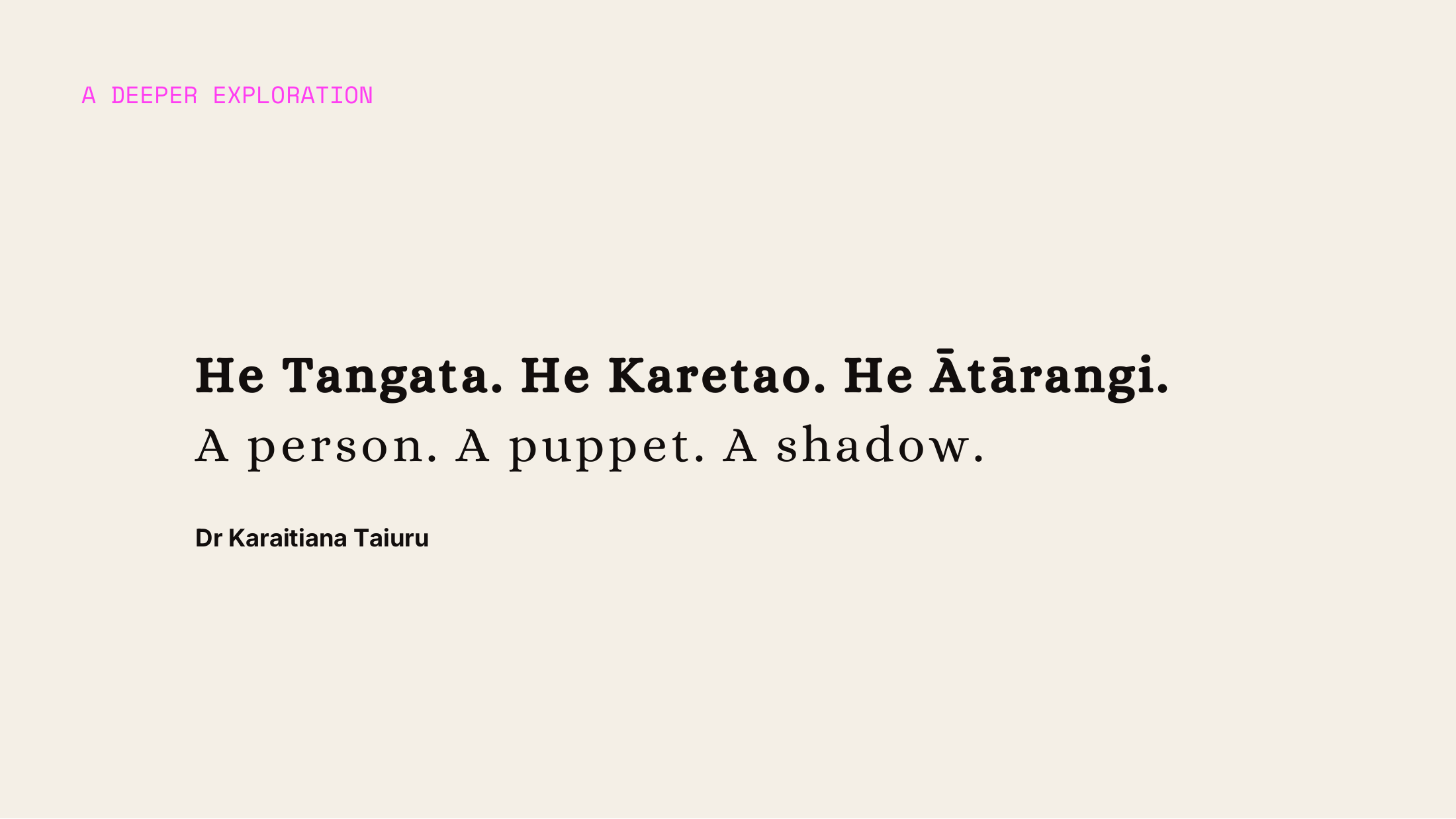
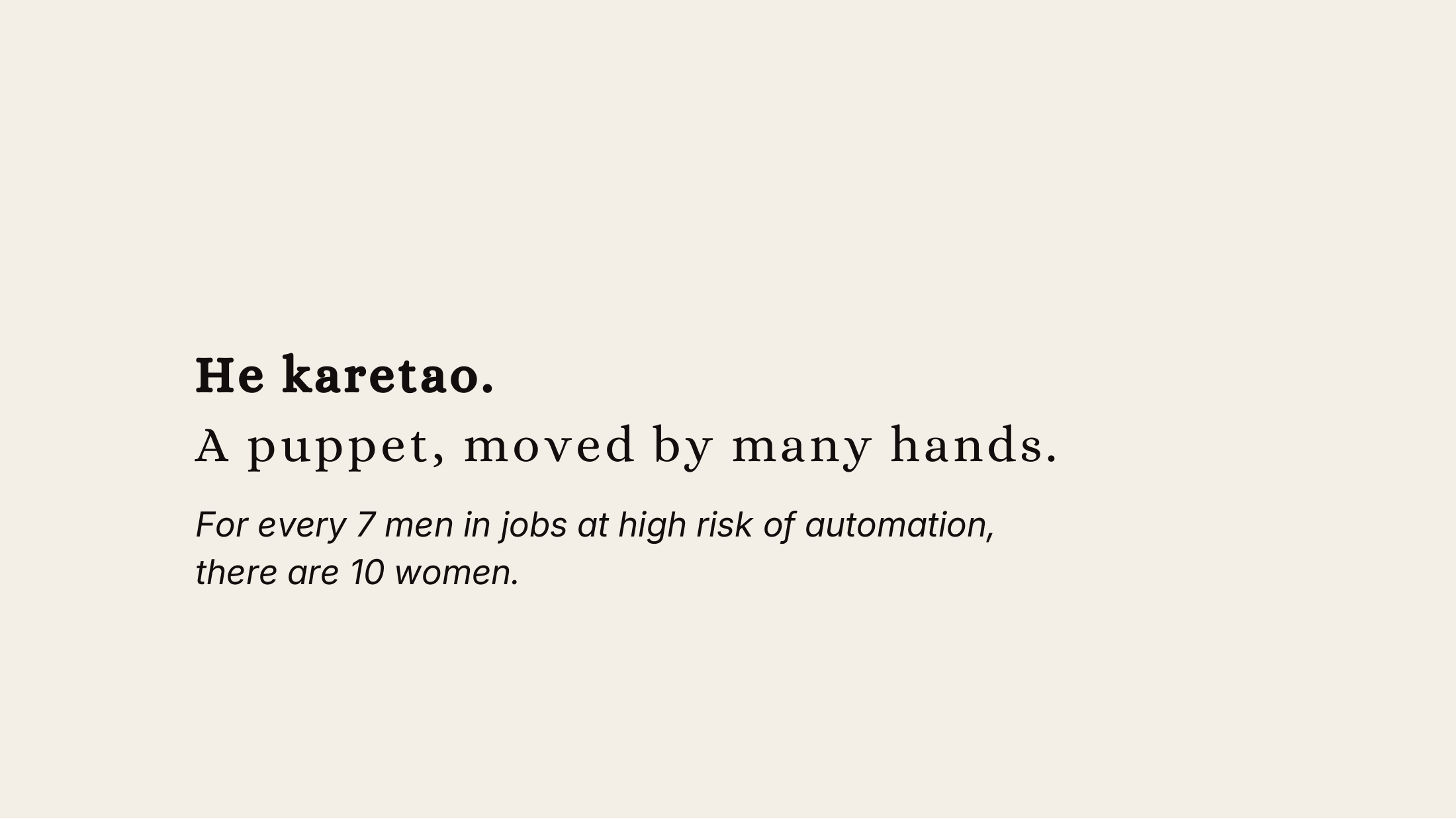
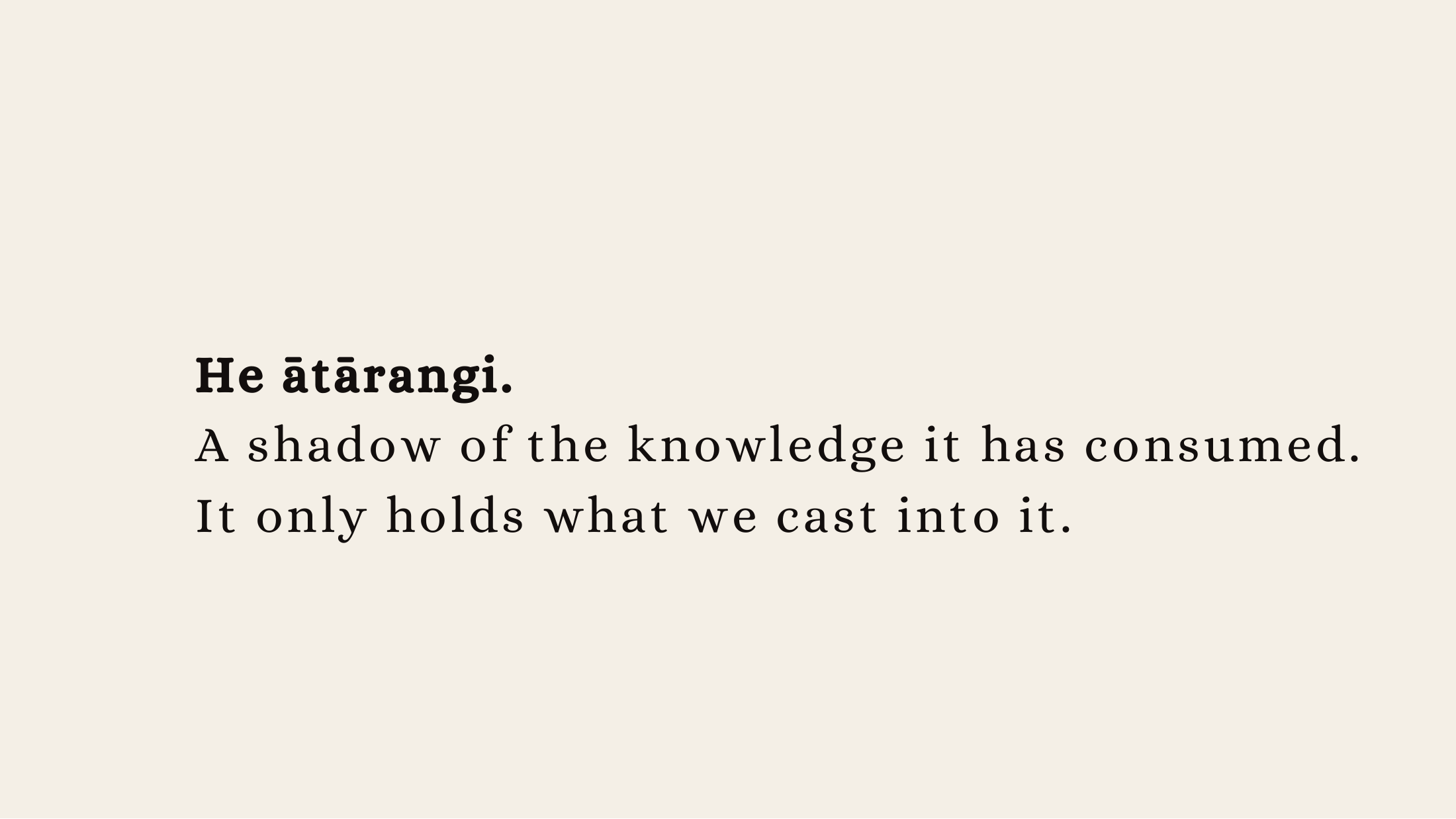
Two things help. Be intentional, use AI where it genuinely saves you real work rather than reflexively for everything. And read the people doing the real reporting. Karen Hao's Empire of AI (linked in the Deep Dive section below) digs into the human and resource costs, and Dr Karaitiana Taiuru's kaupapa Māori framework, he tangata, he karetao, he ātārangi, a person, a puppet, a shadow, is a grounded way to hold both the usefulness and the cost at the same time. Several of you raised this at the stations too, so you're not alone in sitting with it.
I heard AI is "spiralling downwards" in quality because good inputs, like university and healthcare research, are being cut off. True?
asked anonymously
+
I heard AI is "spiralling downwards" in quality because good inputs, like university and healthcare research, are being cut off. True?
asked anonymously
Great question, and there's a real thing underneath it. Two worries usually get mixed together. One is "model collapse," the fear that as the internet fills with AI-generated content, models trained on that slop start to degrade. It's a genuine research concern, but the labs are very aware of it and are leaning on curated and licensed data, not just scraping the open web.
The other is quality sources, news, research, universities, healthcare, increasingly blocking or charging for their data. That part is true, and it's why companies are now signing licensing deals to keep access. So far, each generation of model is getting more capable, not less. But your instinct is sharp: the quality of what goes in absolutely shapes what comes out, which is the whole reason we banged on about "context" all night.
Is there cultural or geographic bias built into these tools, showing up in the outputs while it's all still fresh?
Jessica
+
Is there cultural or geographic bias built into these tools, showing up in the outputs while it's all still fresh?
Jessica
Yes, very much, and you're right that it's worth naming while it's early. These models are trained mostly on English-language, US-and-Europe-heavy internet, so the "default" voice, examples, spelling and assumptions skew that way, and te ao Māori, Pasifika and even plain NZ context are underrepresented. You'll see it in American spelling, northern-hemisphere seasons, US examples, and a flattening of anything outside the mainstream.
The fix on your end is context: tell it you're in New Zealand, who your audience is, the reo or kupu you use, your spelling, and it adjusts well. The deeper issue, whose knowledge is in the model at all, is exactly what Dr Taiuru's framework (linked in the Deep Dive section below) speaks to. Treat the default output as a first draft with a worldview already baked in, not a neutral truth.
Marketing, and being found
Is AI search the end of traditional Google SEO, AdWords, the lot?
Laura
+
Is AI search the end of traditional Google SEO, AdWords, the lot?
Laura
Not the end, but a real shift. People increasingly get their answer straight from AI, Google's AI Overviews, ChatGPT, Perplexity, without clicking through to a website. So "rank number one on Google" matters a little less, and "be the source the AI quotes" matters more. People have even started calling this AEO or GEO, answer or generative engine optimisation.
The good news is the fundamentals overlap. Clear, genuinely helpful, well-structured content about what you actually do still wins, because that's what the AI pulls from too. AdWords isn't dead, but expect click-throughs to soften over time. This is exactly the kind of thing Lian digs into in a website audit.
Using AI to market the business and bring in clients, open homes, listings, the lot.
Leanne, Konnie
+
Using AI to market the business and bring in clients, open homes, listings, the lot.
Leanne, Konnie
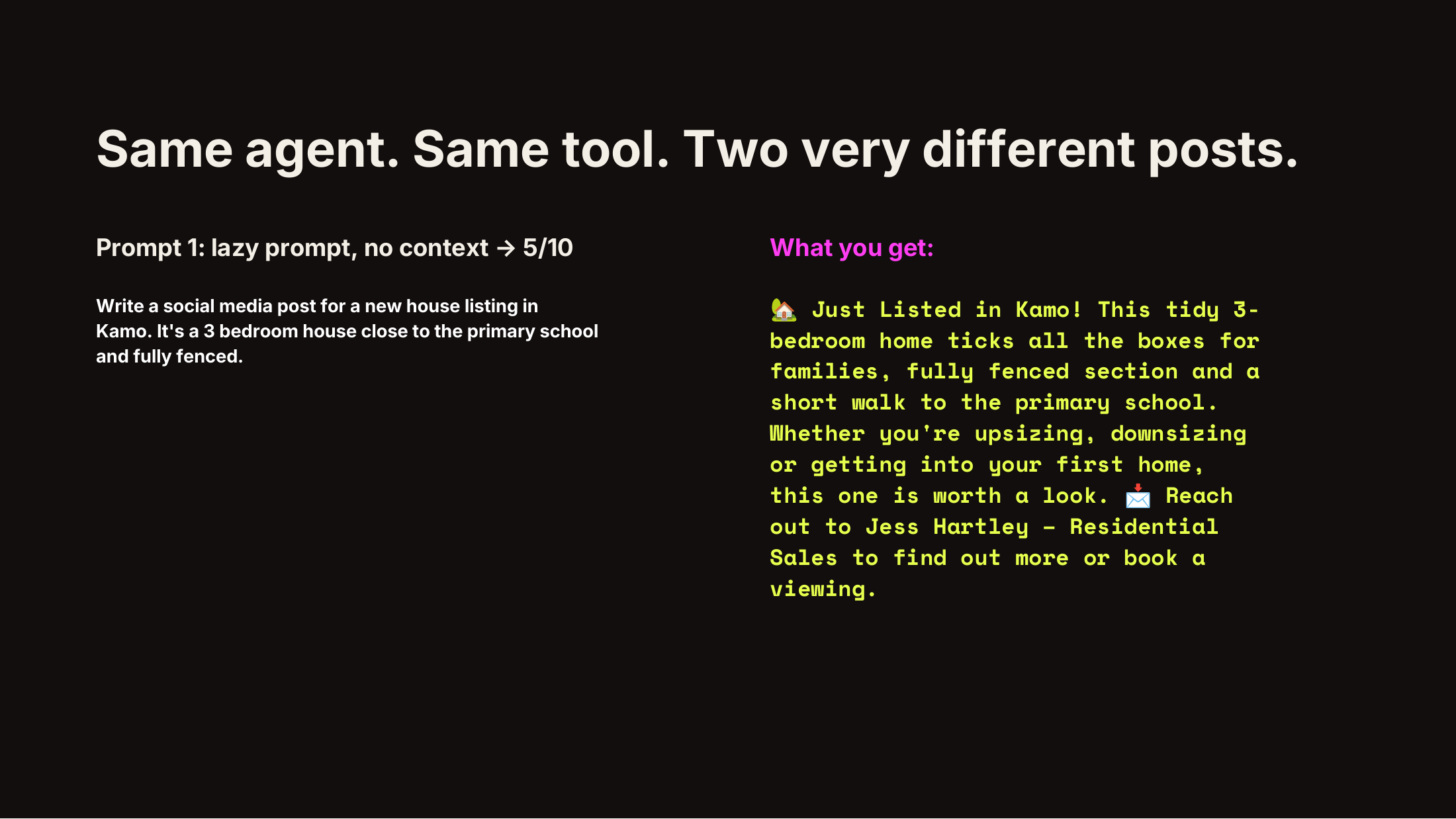
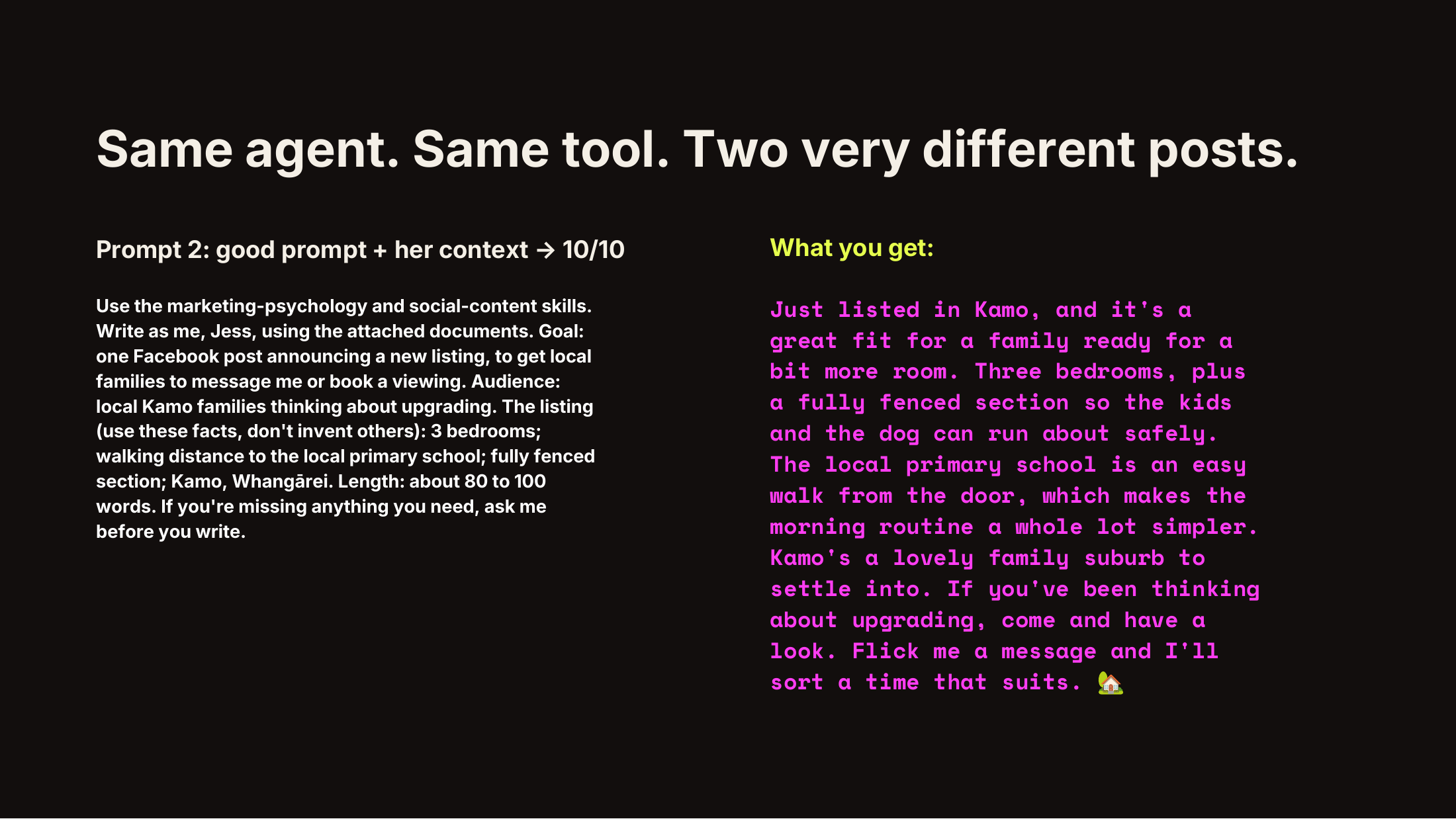
This is exactly what the live demo was built to show. Same tool, same task, two very different results depending on the context you give it. For listings and open homes, the move is to build your context once, who you are, your patch, your voice, the kind of buyer you want, and then every post, every listing blurb, every follow-up comes out sounding like you and pitched at the right people, in a fraction of the time. The Jess example in the slides, a real estate agent and a Kamo listing, walks through precisely this, the lazy version versus the good one. Start there.
A client researching us with AI might get an answer that misses our nuance, our holistic approach, our unpublished work, and come back unenthused. How would you handle that?
Amber
+
A client researching us with AI might get an answer that misses our nuance, our holistic approach, our unpublished work, and come back unenthused. How would you handle that?
Amber
This is a brilliant, very modern problem. AI flattens nuance. It gives the "average" answer and struggles with the holistic, the unpublished, the genuinely different thing you do. Two moves.
First, make your own material the best source on you. AI mostly reflects what's publicly written, so if your website, profiles and content clearly explain your philosophy, your nuance and your evidence, you shape what the AI says about your field, and about you. A thin or absent online presence just leaves the AI to fill the gap with generic or competitor framing.
Second, when a client arrives with a flat AI answer, treat it like any other objection: "That's the textbook version, here's what it misses, and here's why." It's an opening to show exactly the depth AI can't. The businesses that lose here are the invisible ones. The ones that win have a clear, well-documented point of view online.
And a note on Katie's question.
+
And a note on Katie's question.
Katie from Rumours Cafe asked how a small cafe could create a month of social content in a few hours while keeping it local and authentic. That question became our live demo on the night, so rather than answer it twice, the slides on the hub walk through exactly how it was done.
Every question that came in at registration
Kept word for word, names removed
+
Every question that came in at registration
Kept word for word, names removed
This is everything people wrote when they registered, exactly as written. We've taken the names off. A lot of these are answered in the themes above, we grouped the common ones together.
- Just trying to make sense of it all, not be left behind.
- How to streamline some of my admin etc with AI.
- How can I streamline menial tasks in my day at work.
- How is AI going to help me get more clients.
- Building apps with AI.
- Where do I start?!
- I'm just here to learn!
- How AI can help me at work!
- How AI can help build a supervision pakihi that specifically focuses on clinical probationers and connection.
- How can a small café use AI to create a month's worth of social media content in just a few hours while still keeping it authentic and local? Or, if you owned a small cafe with limited staff, what are the top three AI tools you'd implement tomorrow to save time and increase profit? Really, I'd like to learn more about how to use AI to my advantage to help run my business. I know the hours spent on admin and social media can be reduced, but I don't know how to get to that point.
- How we can use AI to enhance our business operations.
- I'm here purely for the learning and the company! Sounds like it's going to be a very informative and good night for the women in business.
- What course or paper would I need to upskill myself to get into roles with AI?
- Data security and maintaining authenticity.
- Support my friend and learn what AI can do to make my job easier.
- To learn what other tools are available other than ChatGPT, and how I can get better info out of it.
- How could I use AI to become more efficient.
- How do you see us working with AI in 2 to 5 years?
- The best way to use AI tools at open homes, listings etc, to market ourselves.
- I want to implement it into the business but stay realistic, what do you suggest?
- Nothing, I'm going in blind.
- Make connections.
Got a question? Ask us.
Thought of something since the night, or never got to ask it? Send it through. We're still reading these and answering the good ones in writing. No question is too basic, that's the whole point. If you'd rather it didn't have your name on it, tick the box.
We'll keep submissions open for a few more days, then close them off.
Want to keep going? Start here, free.
Larissa's Demystifying AI module picks up where the night left off. Everything we deliberately didn't cram into one evening, at your own pace. The first module is free, opt in and Larissa will be in touch with your access.
We'll be in touch with your access at some stage.
For everyone
Larissa's AI skills file
A ready-made set of AI skills Larissa put together, yours to take home. No catch, it's for every single person who came.
Download the skills fileFor your own business use only. These skills are Larissa's intellectual property, shared with you to use inside your own business. Please don't resell, redistribute, or use them commercially.
For everyone
Larissa's quick-reference one-pager
A printable cheat sheet of go-to prompts from Larissa, the quick reference to keep next to your screen.
Download the one-pagerFor your own business use only. This one-pager is Larissa's intellectual property, shared with you to use inside your own business. Please don't resell, redistribute, or use it commercially.
If something landed and you want to go deeper, start here.
Dr Karaitiana Taiuru's framework +
He tangata, he karetao, he ātārangi. A person, a puppet, a shadow. One of the clearest ways we have found to understand what AI actually is.
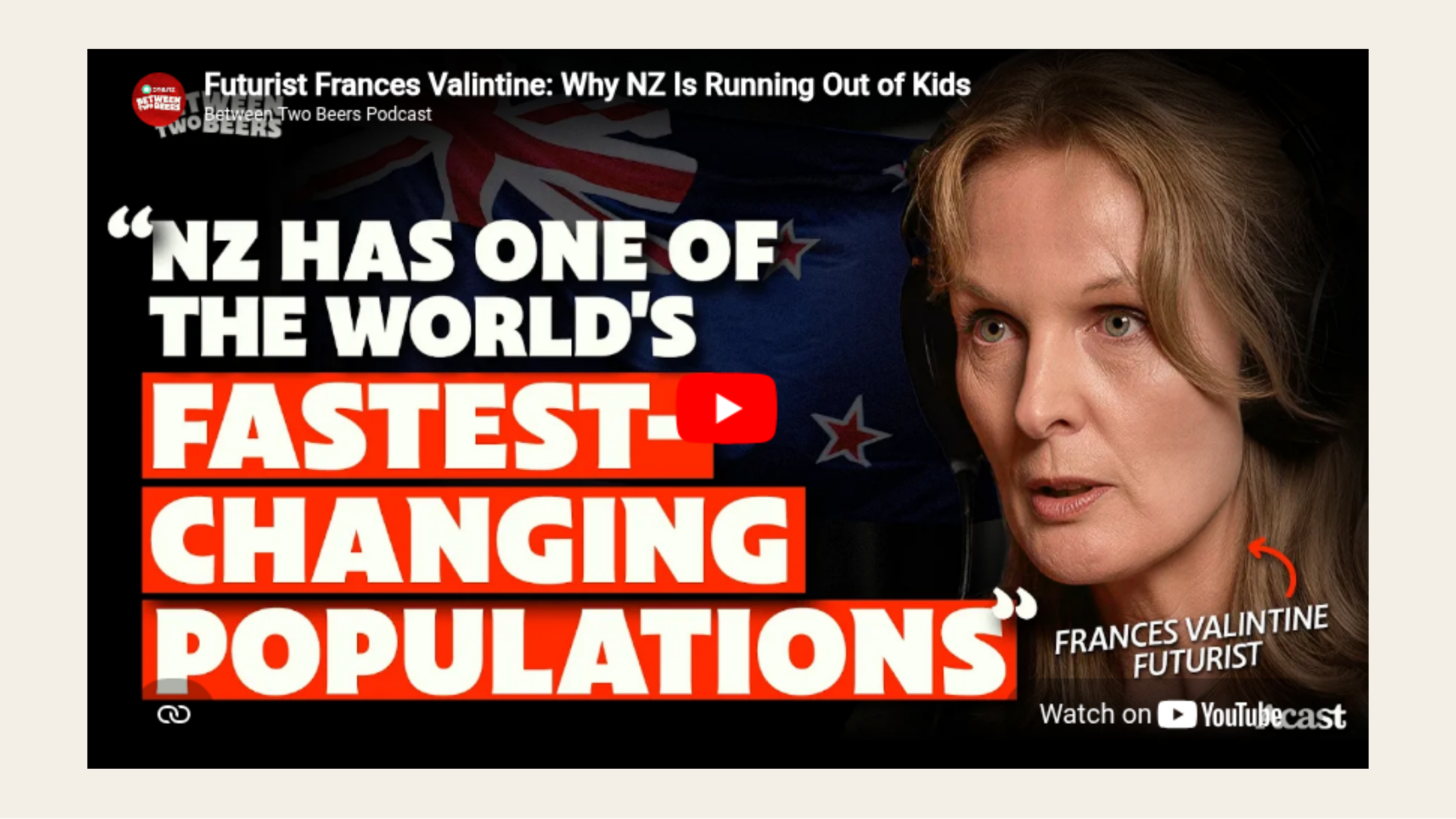
Frances Valintine on Between Two Beers +
Her full long-form chat on the Between Two Beers podcast, automation risk, the future of work, and why AI adoption is becoming an essential capability.
Karen Hao, Empire of AI +
The eyes-open read on who is building this technology and the real human resource costs underlying it.
This doesn't end here.
FTWR Community
A space for women working out AI, business and the future together. No tech background needed. The future belongs to the curious.
The Podcast
Same kaupapa, coming soon. Want to know when the first episode lands?
We're not done with you after one night.
Here's how to keep going, whether that's with one of us, or both.
Larissa
If there's one person who knows Claude inside out, it's Larissa. She works with businesses of every shape and size to get Claude set up and actually working the way they work, not the generic out-of-the-box way. One-woman show or a whole team, if you're using Claude, or you want to, she's the one to talk to.
Lian
Lian works with small and medium businesses on their AI strategy. If you genuinely don't know where to start, she'll sit down with you for an hour and get you pointed in the right direction. Larger organisation after a thinking partner? She builds proper strategy roadmaps as your AI strategist. And when there's something to actually make, she does personalised builds, taking an idea and turning it into a real product, or building the apps and tools that solve the problem in front of you.
Not sure which one you need? Get in touch and we'll work it out together.
More of this, and workshops.
Together we make the Follow the White Rabbit podcast, and we're keen to run a lot more of these. Your feedback already told us you want hands-on workshops, which is exactly where we're heading, real chances to roll your sleeves up and do the thing, not just hear about it. We'll share more soon, here and on the podcast. Keep an eye out.
Tell us how we did, and what you want next.
This was our first one. We want to run more, and we would rather build the thing you would actually turn up to than guess. 30 seconds.
What happens to your answers
What we collect: the ratings and answers you give above, along with the first name and email you entered to unlock this page, so we can connect feedback to the people who came.
How we use it: only to understand how tonight landed and to plan future events, and, now and then, to let you know about the next one. Nothing automated, no spam.
Who can see it: just Lian and Larissa, the two of us who run Follow the White Rabbit. We never sell it or share it with anyone else.
Where it lives: securely in our database (Supabase), hosted in the Asia Pacific region. You can ask us to show you what we hold or delete it any time, just email lianpassmore@gmail.com.